[ CERVOX Reasoning ]

AI SPEAKS ON YOUR BEHALF. YOU HAVE NO CONTROL OVER WHAT IT CLAIMS.

CERVOX Reasoning makes your rules executable, verifies every piece of information and then checks every sentence before it goes out: upheld, contradicted, or outside the corpus — with the source and the trace.

You keep your AI tools · Invisible module · No habits to change

Reasoning
[ WHO IS IT FOR? ]

IF YOU USE AI, THIS QUESTION CONCERNS YOU.

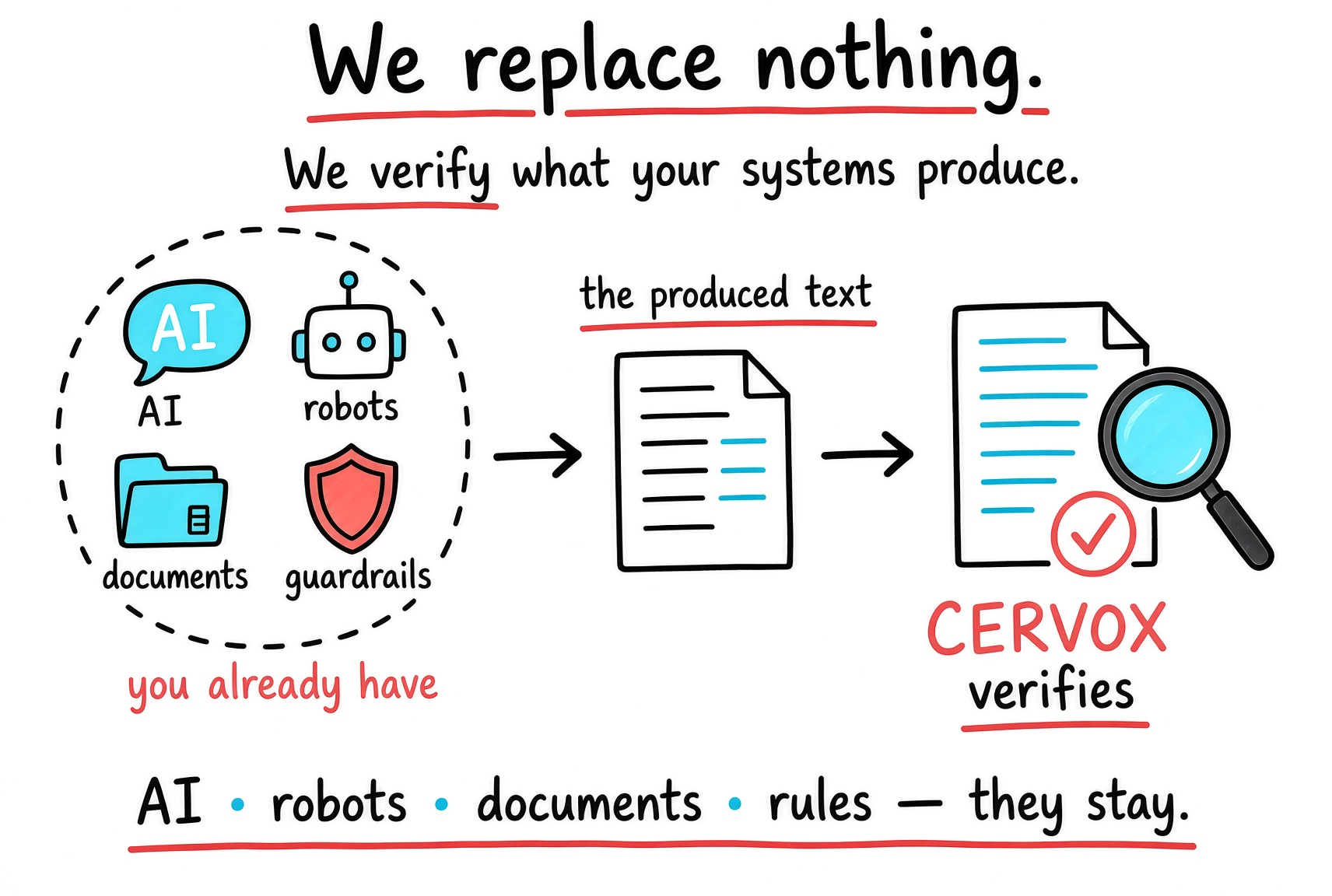
Diagram: we replace nothing, we verify what your systems produce. Your AI, your robots, your documents and your guardrails stay in place; CERVOX verifies the text they produce.

YOU ALREADY USE AI.

ChatGPT, Claude, Copilot, a business-specific AI, agents or bots. Whatever the tool: CERVOX Reasoning works on what it produces.

YOU HAVE A REFERENCE BASE.

Procedures, contracts, internal policies, business rules, documentation or a document corpus: you have material against which the answers produced must be checkable.

YOU ALREADY HAVE SAFEGUARDS.

Prompts, RAG, workflows, human validation or internal rules: these mechanisms stay in place. CERVOX Reasoning adds a verification layer when you need to know whether a statement really holds up against your references.

YOU DON’T NEED TO CHANGE YOUR AI. YOU NEED TO KNOW WHAT IT CLAIMS.

[ The technology ]

THE ENGINE: AUTOMATED REASONING ON AMAZON BEDROCK.

Automated Reasoning turns your business rules into formal logic, then verifies the answers produced by AI against those rules.

AI produces. The engine verifies. Your rules remain the reference.

Automated Reasoning

Verifies the rules.

Contextual Grounding

Verifies the documentary support.

RAG

Retrieves the sources.

RAG retrieves. Grounding supports. Automated Reasoning verifies.

[ DOCUMENTED USE CASES ]

WHERE THIS TECHNOLOGY IS ALREADY IN USE

Documented cases show how Automated Reasoning verifies AI decisions when rules must be followed.

Documented use case · AWS

AMAZON LOGISTICS

Engineering · Compliance

The problem

Proposals for electric vehicle charging stations must meet technical specifications and regional regulatory requirements.

The control

Automated Reasoning turns the rules into formal logic and verifies the parameters extracted from the proposals.

What it delivers

≈ 8 h → a few minutes

Formal verification of every determination.

Result reported by AWS.

Documented use case · AWS

LUCID MOTORS × PwC

Finance · Forecasting

The problem

Agents produce financial forecasts that must comply with predefined rules and constraints.

The control

Automated Reasoning verifies the model outputs against these financial rules and constraints.

What it delivers

WEEKS → < 1 MIN

Generation of forecasts verified against the defined constraints.

Result reported by AWS and PwC for the forecasting solution as a whole.

Documented use case · AWS

FIRST EDUCATION & TECHNOLOGY GROUP × PwC

Education · Safety

The problem

AI answers intended for education must comply with data protection and student safety rules.

The control

Compliance principles are translated into formal rules, then AI answers are verified against those rules.

What it delivers

UP TO 80%

reduction in the effort to set up the rules

50 %

reduction in the ongoing compliance workload

Results reported by AWS and PwC.

Documented use case · AWS / PwC

UTILITIES

Energy · Incident management

The problem

AI-generated procedures and plans must meet regulatory and operational requirements.

The control

Automated Reasoning verifies the generated protocols and plans against the defined rules.

What it delivers

Real-time plan validation and workflows adapted to the severity level.

Use case described by AWS and PwC.

Cases publicly documented by AWS and its partners — sources: AWS Machine Learning Blog, AWS and PwC case studies. The results shown are those reported by these sources.

Technical details

  • Automated Reasoning. A formal policy is built from your source of truth and the rules validated by your expert. The submitted text is translated into logical terms, then a logic engine checks whether each conclusion follows from that policy. This translation relies on language models; the computation of the conclusion, however, is logical. Automated Reasoning does not check the text against your raw documents: it checks it against the policy built from them.

  • Contextual Grounding. For editorial content, it assesses whether the statement is grounded in the source passages. It is an assessment: the verdict is supported, never presented as proven.

  • Retrieval (RAG). Finds the relevant passages in your source of truth for each statement. It is a component, not the product: it renders no verdict.

  • Contradictions. The comparison reveals the points where the text contradicts your documents and, at initialisation, the places where your own rules contradict each other.

[ HOW IT DECIDES ]

THE MODEL PREDICTS THE NEXT WORD. THE CONTROL ASKS: CAN THIS SENTENCE BE FALSE?

LLMS PREDICT LANGUAGE. CERVOX GIVES AI A FRAMEWORK TO REASON, VERIFY AND CONCLUDE ACCORDING TO YOUR RULES.

DimensionWHAT LLM LANGUAGE DOESWHERE IT HURTSWHAT CAUSAL REASONING DOES

MECHANISM

It predicts. Each word is the most probable one after the previous ones.

Probability is not a rule. A fluent error has no address.

It deduces. The sentence becomes an implication: if these facts, then this statement. The implication is tested against your rules, not against an average of texts.

RELATIONSHIP TO YOUR DOCUMENTS

Even when “sourced”, the model writes and judges itself. An excerpt pasted next to a false sentence is still reassuring.

Two employees, same question, two answers. Nobody holds the current version of the procedure.

Your documents become a system: typed variables, obligations, conditions, exceptions. An expert validates the rule in French. The model is no longer judge and party.

THE QUESTION ASKED

“Does it look like our texts?”

Looking alike doesn’t prevent the exception from being dropped. If “unless” disappears, the text still reads well.

“Is there a case, allowed by our rules, where this statement is false?”

Zero cases: upheld. One case: contradicted. Both: incomplete.

WHAT YOU SEE

A sentence. Sometimes a score. Sometimes a quotation.

Nothing to show on the day someone asks: “What did you base this on?”

A verdict + the rule behind it + the variable assignments (seniority, status, threshold…) + the trace: who, when, which version of the document.

THE CASE THAT CATCHES EVERYONE OUT

The answer isn’t false. It is only true under an assumption it doesn’t state.

It passes a quick review. It has already gone out.

The system returns both worlds: the one where it is true, the one where it is false.

The hidden assumption becomes visible.

This is control, not comfort.

WHEN IT STAYS SILENT

It never stays silent. It always has a sentence.

Silence would have been safer than an invented opinion.

If it cannot translate the statement into your rules, it does not rule on it.

Outside the corpus, too ambiguous, conflicting rules: the verdict states that it cannot judge, not a false certainty.

[ CONTROL, IN PRACTICE ]
01

YOUR RULES

Your procedures are structured: who, under which condition, unless, with what effect.

02

YOUR AI

AI produces a text, on your premises, in the tool you already have.

03

THE STATEMENTS

The text is split into statements.

04

THE TEST

Each statement is translated into logic, then tested: can it be false with respect to the validated rule?

05

THE VERDICT + THE TRACE

You receive the verdict, the rule that explains it, the source passage, the trace.

A source of truth, not a better prompt.

[ AT A GLANCE ]

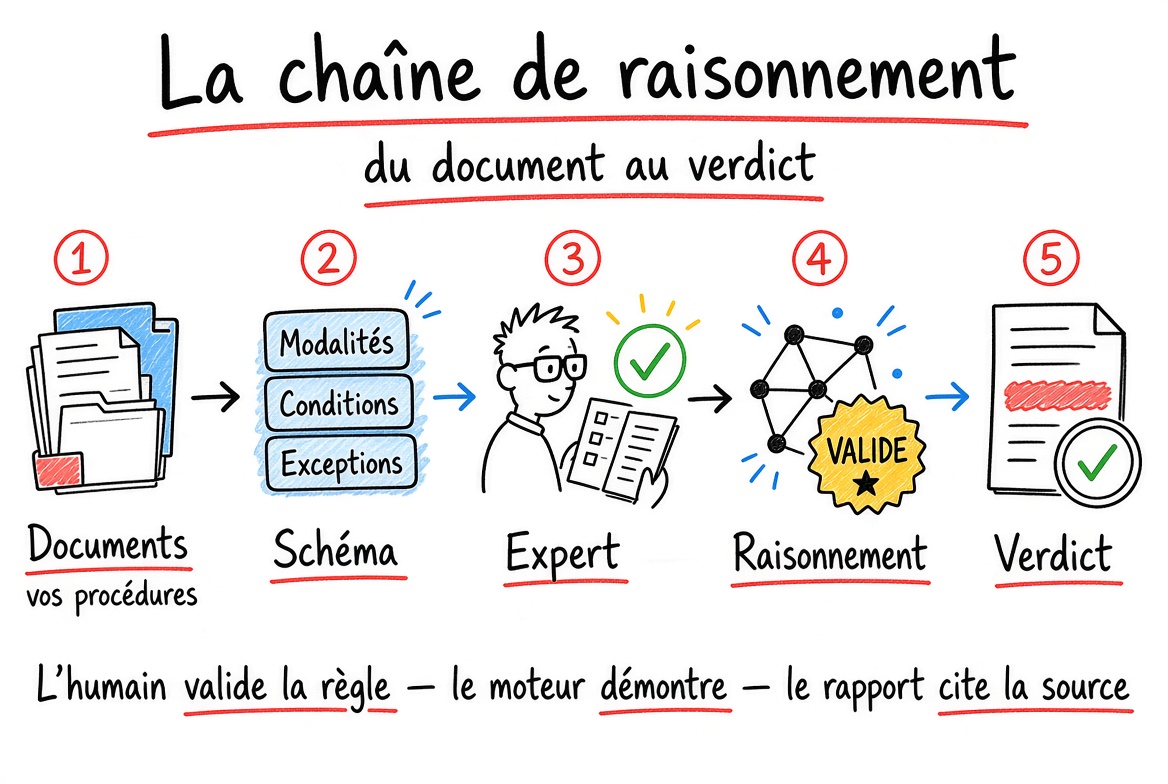
Diagram: the reasoning chain, from document to verdict. Your procedures, the rule schema (modalities, conditions, exceptions), validation by the expert, the reasoning, the verdict. The human validates the rule, the engine proves, the report cites the source.
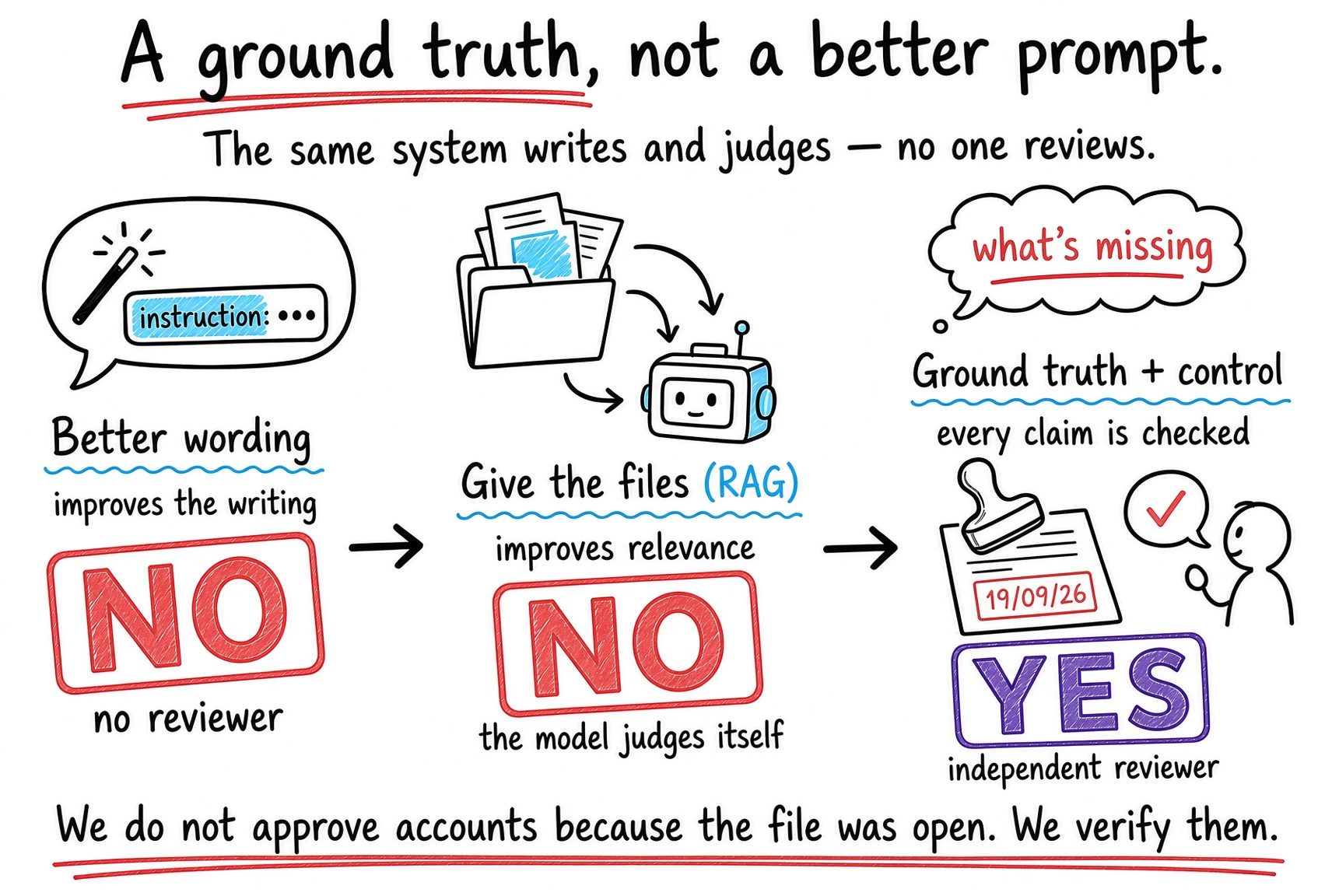
Diagram: a ground truth, not a better prompt. The same system writes and judges, no one reviews. Better wording improves the writing: no reviewer. Giving the files to the model (RAG) improves relevance: the model judges itself. Ground truth and control: every claim is checked, independent reviewer. We do not approve accounts because the file was open. We verify them.
[ HOW IT IS DEPLOYED ]

YOU KEEP YOUR TOOLS. CERVOX ADDS THE CONTROL.

Deployment starts with your uses, your documents and your rules. CERVOX builds the verification layer with your team, then it fits into the way you work.

  1. FIRST CONTACT

    We start by understanding your organisation, your uses of AI, the areas concerned and the rules you want to control.

  2. YOUR REFERENCE BASE

    You provide us with the relevant documents: procedures, contracts, internal policies, business rules or documentation. They are organised by area to form the reference base.

  3. YOUR EXPERT VALIDATES THE RULES

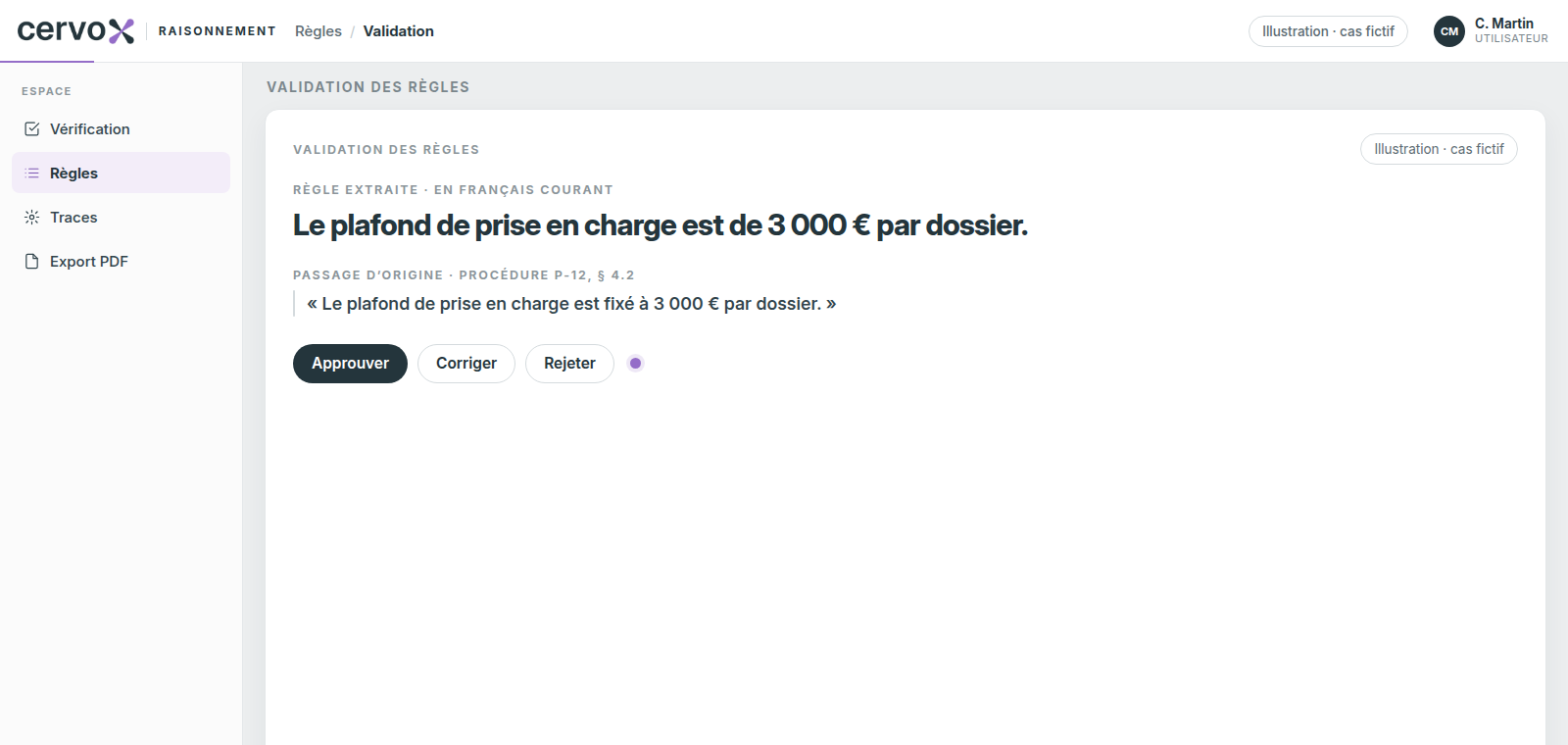
    The extracted rules are presented in French, with their source passages. Your expert approves, corrects or rejects them.

    ApproveCorrectReject

    You validate what the system has understood. The engine then verifies the rule.

  4. YOUR TOOLS STAY IN PLACE

    You keep using your usual AI environment. CERVOX adds a verification layer on the outputs you choose to control.

    Two modes of use: verification after production or a verified conversational workspace. See both modes ↓

  5. CERVOX VERIFIES

    The text is split into statements, checked against the validated rules and references, then returns a result with a status, sources and a trace of the verification.

YOUR AI KEEPS PRODUCING. YOU KNOW WHAT IT CAN CLAIM.

Verification relies on the rules and references your organisation has validated.

[ How to read it ]

TWO KINDS OF VERDICT. NEVER CONFUSED.

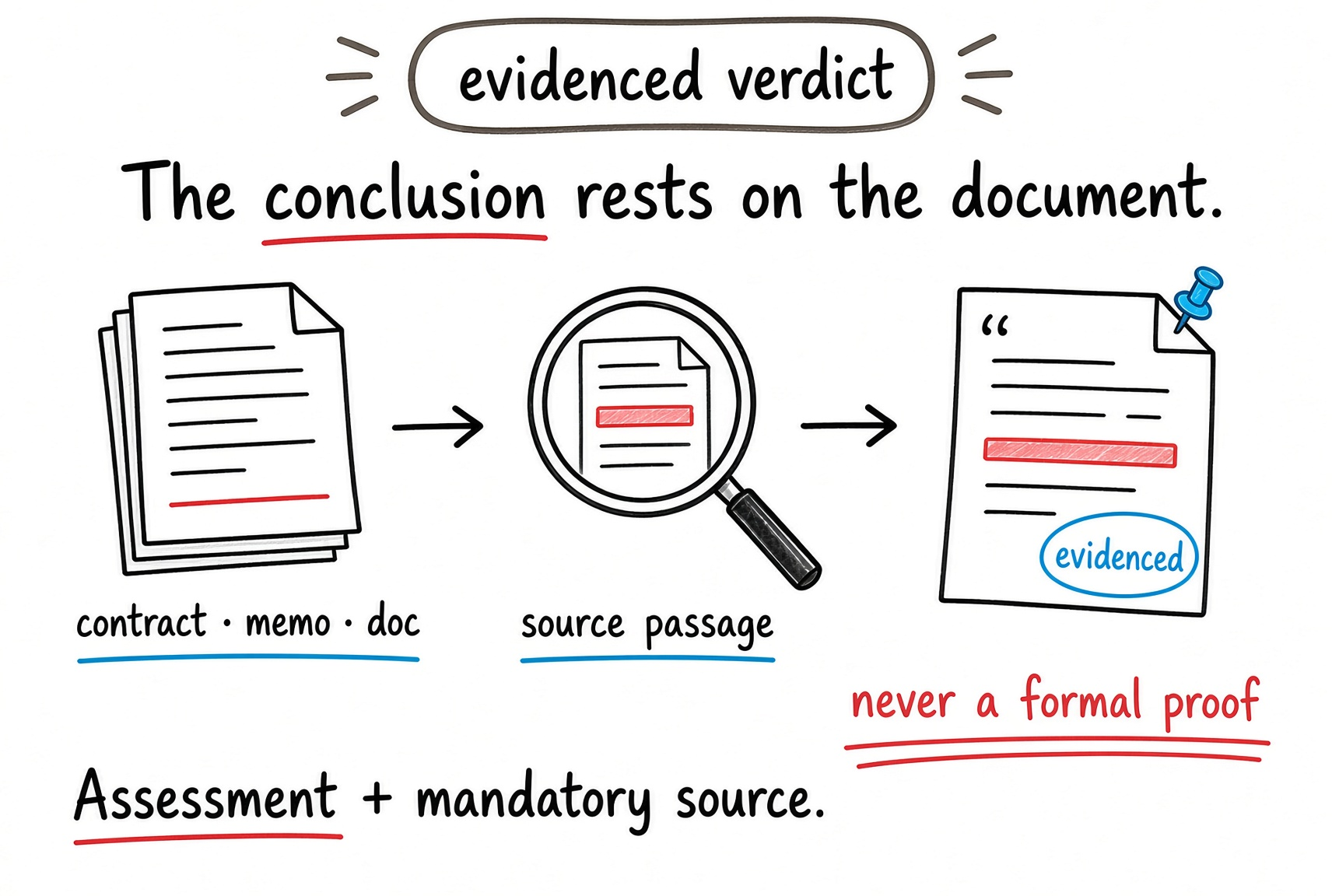
Diagram: evidenced verdict. The conclusion rests on the document (contract, memo, doc) and cites its source passage: an assessment with a mandatory source, never a formal proof.
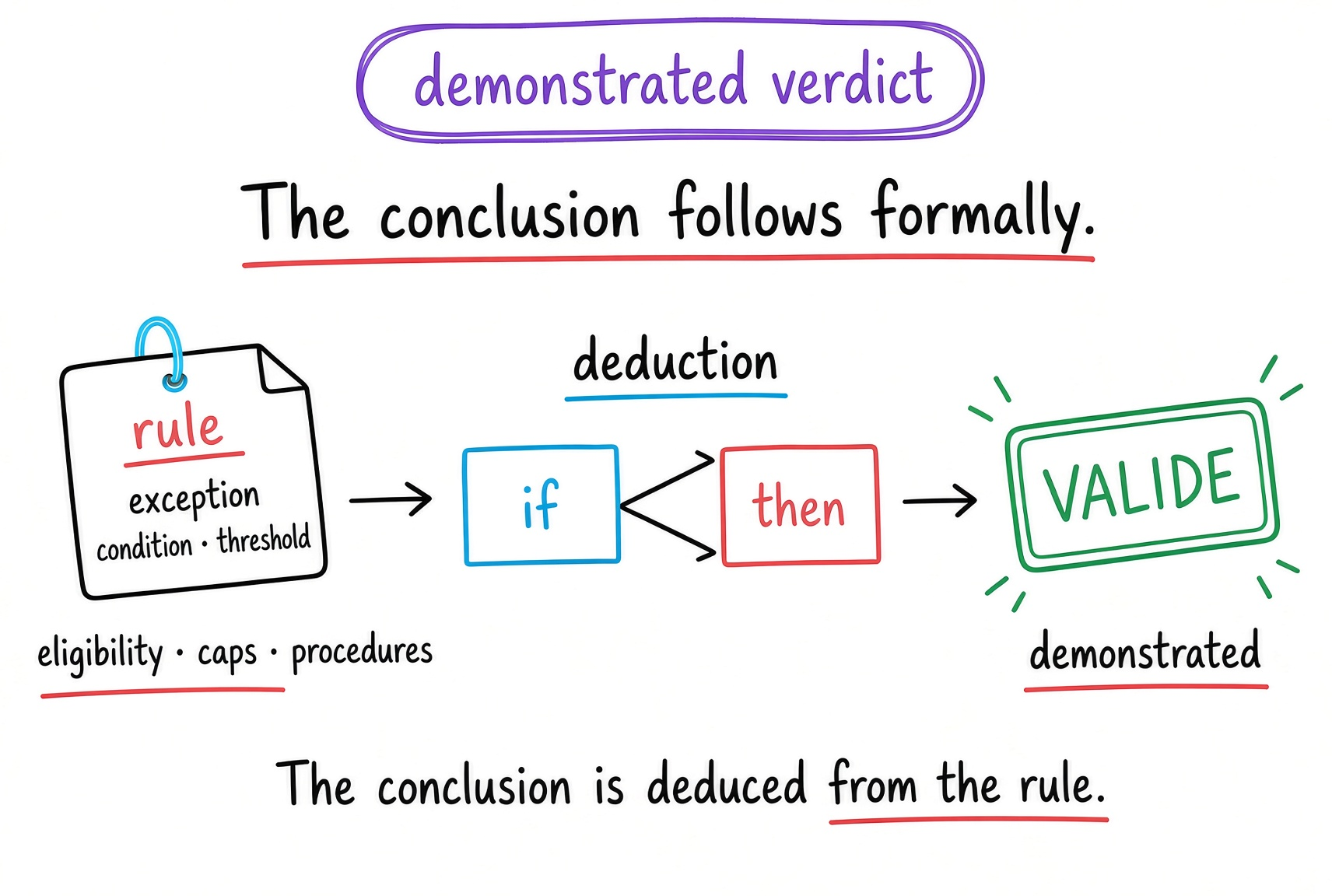
Diagram: demonstrated verdict. The conclusion follows formally from a rule (exception, condition, threshold) by deduction: if… then… The conclusion is deduced from the rule.

Why several source passages for one rule?

Each status points to the passages it derives from. A rule can derive from several passages: the interface shows all the passages concerned, not an artificial one-to-one match.

[ Two ways to use it ]

YOU KEEP YOUR TOOL.CERVOX ADDS A VERIFICATION LAYER.

No migration. The model that generates remains yours, under your contract.

ONE SINGLE CONTROL LAYER.TWO WAYS TO USE IT.

MODE A

AFTER THE FACT

You produce first. CERVOX verifies afterwards.

YOU CARRY ON AS YOU DO TODAY.

You work in your usual tool, then submit the resulting text. You receive a report per statement.

  1. Usual tool
  2. Production
  3. Submission
  4. Verification

MODE B

CONTINUOUS

CERVOX verifies while you use it.

VERIFIED CONVERSATIONAL WORKSPACE.

Every answer goes through the verification layer before being considered usable. It is displayed immediately; the verification status follows.

  1. Conversation
  2. Production
  3. Built-in verification

SAME VERIFICATION LAYER

VERDICTSOURCESTRACE

[ The expert stays in the loop ]

YOUR EXPERTISE REMAINS THE REFERENCE.

You are not asked to review logic. Each rule extracted from your documents is presented to you in plain French, next to its original passage, with a single question: does this correctly express your rule?

APPROVE · CORRECT · REJECT

Your expertise, not a formalism. This step is permanent, by choice: it is what gives the rest its value.

Illustration · fictitious case: a rule in plain French, its original passage in the procedure, and the approve, correct, reject actions.
Illustration · fictitious case. Does this correctly express your rule?
[ What this product does not do ]

EVERY VERIFICATION LEAVES A TRACE.

A verification product cannot promise more than it delivers.

  • IT DOES NOT ELIMINATE ERRORS, IT MAKES THEM DETECTABLE.

  • IT VERIFIES NOTHING BEYOND YOUR CORPUS.

  • IT IS NEITHER A CERTIFICATION NOR LEGALLY BINDING PROOF.

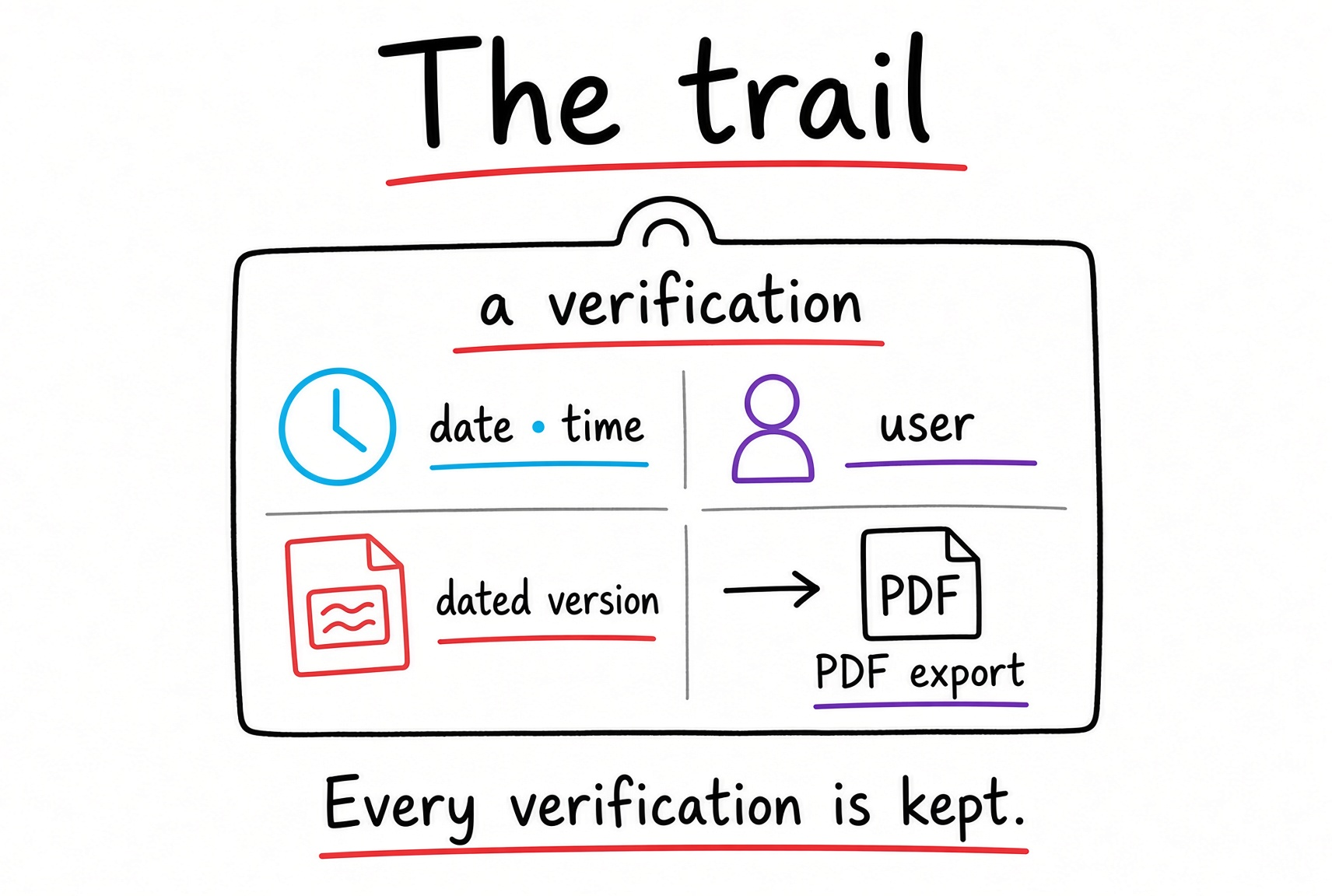
Diagram: the trail. A verification records the date and time, the user, the dated version of the document, and can be exported to PDF. Every verification is kept.
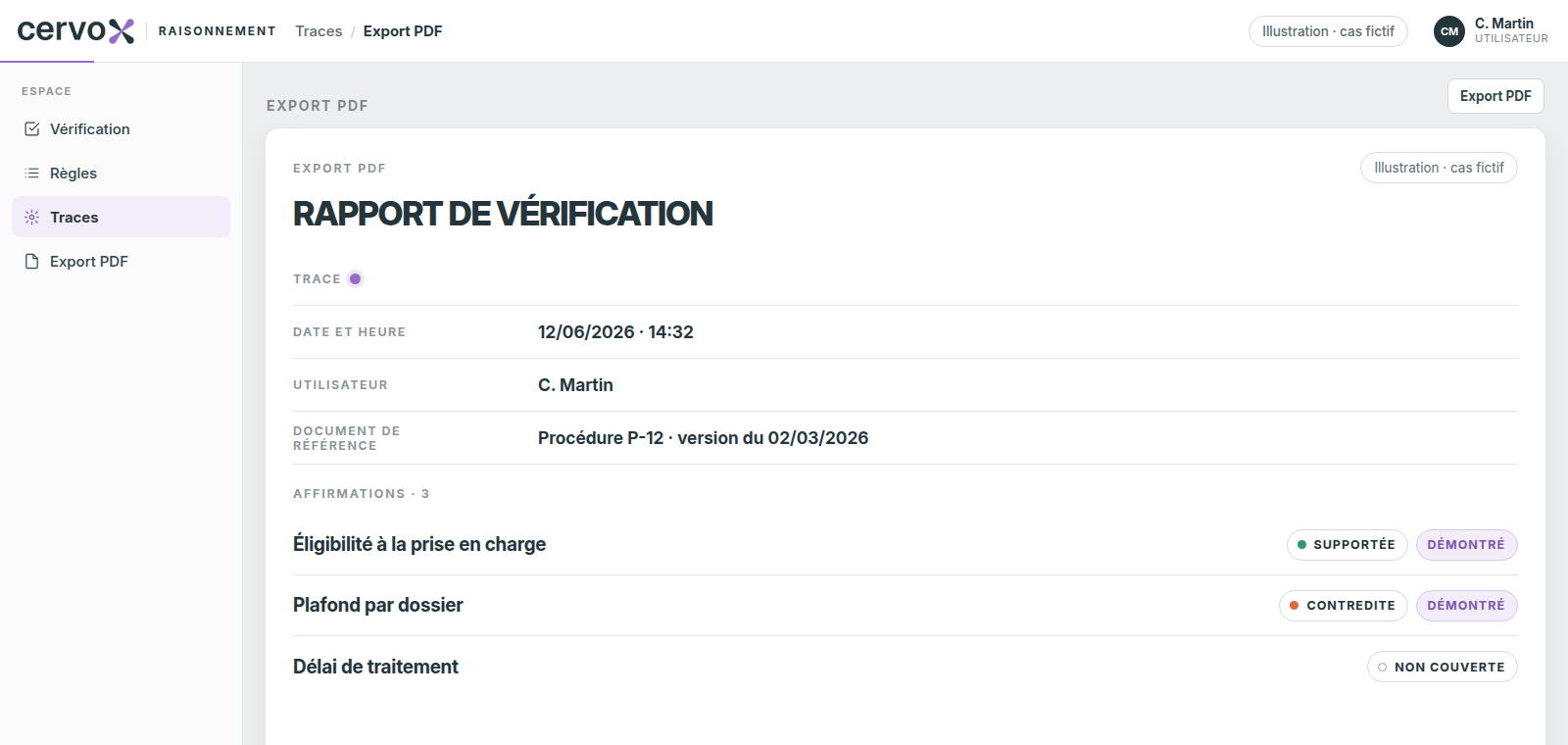
Illustration · fictitious case: verification report exported to PDF, with date and time, identified user, dated version of the reference document and the status of the three statements.
Illustration · fictitious case. Date, user, dated version of the document.

[ Questions we often hear ]

What does the product not do?

  1. It does not eliminate errors. No mechanism makes a language model infallible. The aim is to make errors detectable before they leave the company.

  2. It does not verify beyond your corpus. The quality of the verdicts depends directly on the source of truth provided. Outside that scope, it indicates that the statement is not covered: it does not invent an answer.

  3. It does not replace professional judgement. “Supported” means consistent with the documents provided. Not that those documents were the right ones, nor that they were up to date.

  4. It does not constitute regulatory compliance. The trace is a useful input into a governance framework, not a certificate.

  5. It only sees what goes through it. An employee who stays in a consumer tool without submitting anything escapes verification. The verified conversational mode addresses this point, if it is adopted.

  6. It does not replace your AI provider. It sits on top. Your existing contracts, quotas and uses are not affected.

Does the trace have legal value?

The trace produced is timestamped, attributed to an identified user and linked to a dated version of a document. It is not legally binding proof, and “supported by your documents” does not mean those documents were up to date or appropriate. It is a governance input, not a certificate.

What if an employee stays in a consumer tool?

They escape verification: the product only sees what goes through it. Mode B, the verified conversational workspace, addresses this point if it is adopted. It is also a governance issue: there is often no inventory of AI use, which is everywhere and nowhere, and internal documents circulate in consumer tools, without any framework.

Our AI contracts and credentials?

Your teams keep their AI tool and their access. The model that generates the text remains yours, under your own contract; your existing quotas and uses are not affected. Model credentials are configured at organisation level, encrypted. We do not resell access to models and do not ask you to give up a tool your teams already use. Your business tools stay as they are.

History, roles, scopes?

Verifications can be viewed by user, by area and by period, with separate workspaces and roles.

And professional judgement?

“Supported” means consistent with the documents provided, nothing more. Not that those documents were the right ones, nor that they were up to date. The product does not replace professional judgement.

How do you know the verification works?

On your corpus, we measure the fidelity of the extracted rules, the accuracy of the verdicts — a confident but wrong verdict counts as a failure —, the actual coverage and the quality of the sources.

AI ALREADY WORKS WITH YOUR DOCUMENTS.

The question now is how to stay in control of what it produces when it relies on your rules and your documents.

  • YOUR RULES ARE SCATTERED.

    Procedures, policies, exceptions and business practices can be spread across several documents.

  • SOME RULES REMAIN IMPLICIT.

    Part of the knowledge still rests on the experience of a few people.

  • AI MUST BE VERIFIABLE.

    Answers that commit the organisation must be checkable against a reference base.

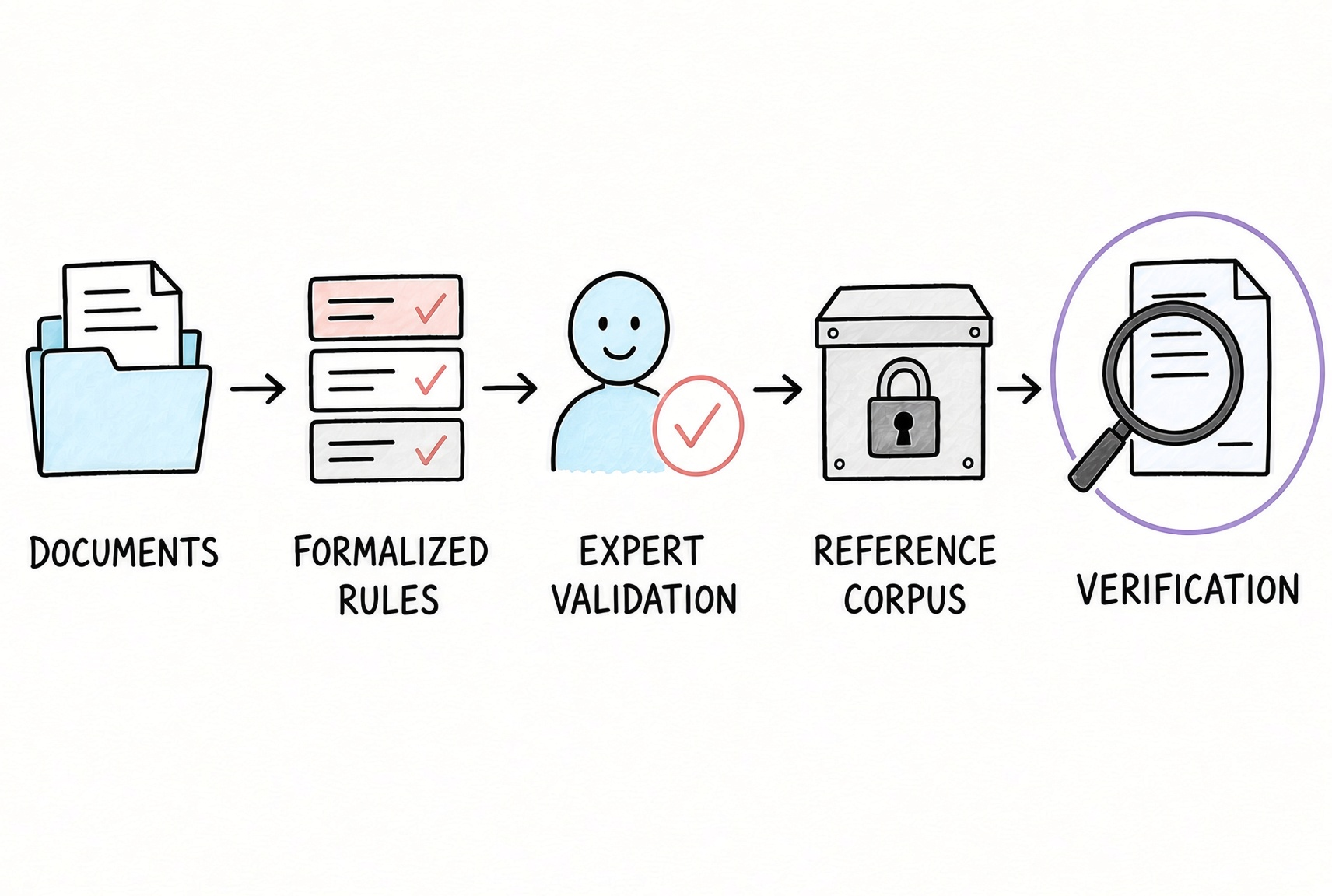
Diagram of the five steps: documents, formalised rules, expert validation, reference corpus and verification.

The Rule Base can be delivered right now. See the Rule Base

WHAT IT CHANGES.

  • MORE CONTROL

    Knowing against which rules and which documents answers can be verified.

  • MORE TRACEABILITY

    Linking rules, sources and verification results.

  • FEWER REPETITIVE CHECKS

    Reducing some manual reviews and checks when rules can be controlled automatically.

  • BETTER KNOWLEDGE RETENTION

    Making business rules explicit, structured and transferable.

The result: better control of the risk associated with AI-generated answers.

[ WHO IT IS FOR ]

Any organisation that uses AI with document resources, rules or business knowledge.

Whatever its size or sector.

Example sectors

  • Industry
  • Banking
  • Finance
  • Insurance
  • Healthcare
  • Consulting
  • Accounting
  • Legal
  • Compliance
  • Regulated professions
[ Get in touch ]

STAY IN CONTROL OF WHAT AI PRODUCES.

Tell us about your context, your uses of AI and the documents that structure your activity. We will look with you at where CERVOX Reasoning can add a useful verification layer.

OUR COMMITMENT: “If the verification doesn’t hold up on your corpus, we tell you and show you why.”

First conversation, no commitment.

Or book a slot directly (new tab)

The information you send is used solely to prepare our conversation. It is not passed on to any third party for commercial purposes. You can request its deletion at any time at contact@cervox.io — see the privacy policy.