

Over the past two years, artificial intelligence has become unavoidable.
Every week brings a new AI agent, a new smart assistant or a new promise to save hours of work.
French SMEs are now looking for:
- how to automate their business;
- which AI agents to deploy;
- which tasks can be automated;
- how to reduce their administrative workload.
This shift makes sense. But one mistake keeps coming back.
Many people think automation simply means connecting ChatGPT or an AI agent to their tools. In reality, it is often the best way to produce… errors faster.
Automation is only valuable if the data it uses is reliable, verified and constantly kept up to date.
Because artificial intelligence does not think. It only works with the information it is given.
The myth of the “magic AI agent”
Today, many solutions promise:
- an autonomous sales agent;
- an HR agent;
- an accounting agent;
- a marketing assistant;
- a smart chatbot.
The idea is appealing. You plug in a few applications. You connect your CRM. You import a few documents. And the AI is supposed to run the business.
Unfortunately, in reality, it rarely works that simply.
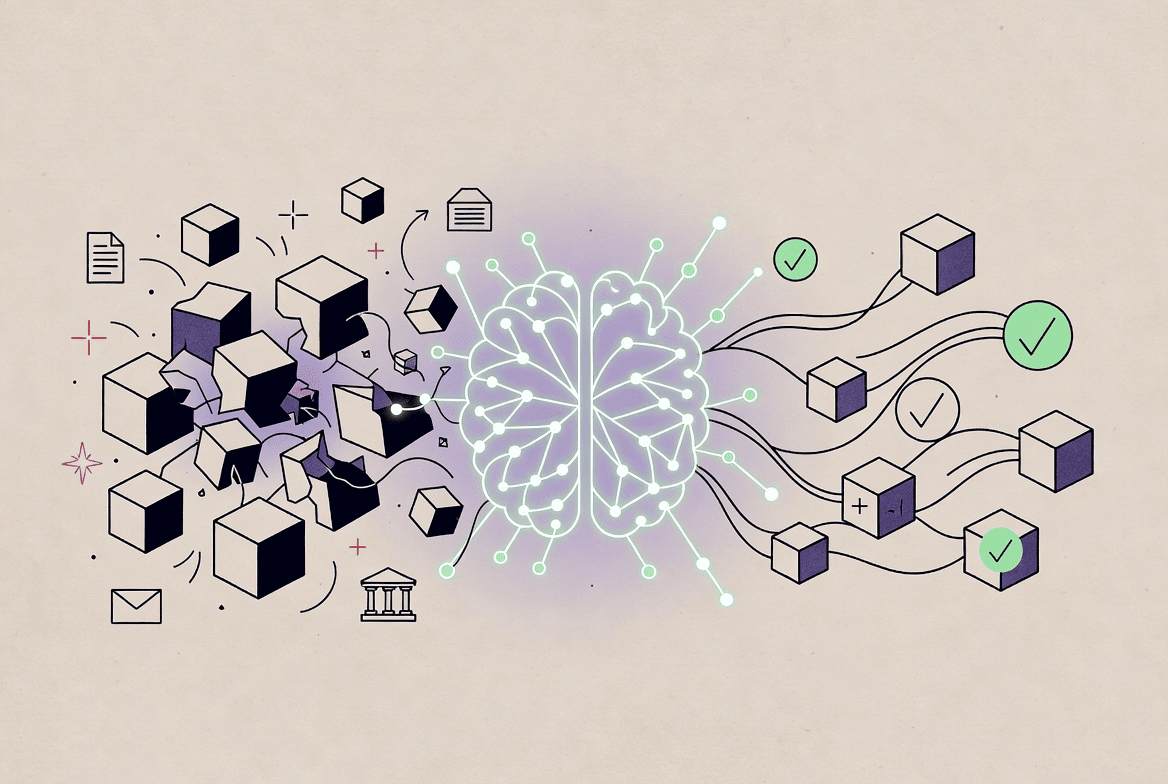
Why? Because companies have scattered data.
- Information in their mailbox.
- Quotes in one piece of software.
- Invoices in another.
- Documents in Google Drive.
- Contracts in Dropbox.
- Forgotten Excel files.
- Notes in Notion.
- Conversations in Teams or Slack.
- Banking information.
- Accounting information.
- HR data.
Each piece of software holds its own truth. None has the full picture.
Wrong data, automated, is still wrong data
Automation speeds up processes. But it also speeds up errors.
Take an example. An AI agent automatically prepares payment reminders. The CRM shows an invoice as unpaid. So the agent automatically sends a reminder.
And yet… The payment was received. But the bank sync had not run yet.
The result: the customer receives an unjustified reminder. A few minutes of automation were enough to damage a business relationship.
The same thing happens in every department:
- recruitment;
- human resources;
- accounting;
- purchasing;
- sales;
- document management.
The AI did not “invent” the error. It simply executed it much faster.
Automation must follow one fundamental rule
Before any action, a piece of data must be:
- collected;
- centralised;
- calculated;
- cross-checked;
- verified;
- validated.
Only after these steps can artificial intelligence make a relevant decision.
That is exactly how an experienced employee works. Before answering a customer, they check several pieces of information. Before signing a contract, they check the data. Before sending an invoice, they check that it is accurate.
Why would we ask less of an AI?
Enterprise 3.0 is built on reliable data
Tomorrow's company will not simply be equipped with several AI agents. It will rest on a genuine cognitive system.
In other words, an architecture able to:
- retrieve data from every piece of software;
- remove duplicates;
- check consistency;
- detect anomalies;
- update information continuously;
- give AI agents reliable context before every decision.
Artificial intelligence should never work alone. It needs a living memory of the company.
From automation to the autonomous company
This is where you move from simple automation to a truly autonomous company.
An autonomous company is not a company without people. It is a company where employees no longer waste time on repetitive tasks:
- finding a document;
- looking for an invoice;
- checking a contract;
- chasing a customer;
- preparing a report;
- monitoring indicators;
- centralising information.
Employees can then focus on high-value decisions. Artificial intelligence takes care of repetitive operations.
The winners will not be the companies with the most AI
Many imagine it is enough to keep adding more AI agents. Within a few years, that approach will quickly show its limits.
The best-performing companies will be those that have built genuine governance of their data. Because effective AI depends above all on the quality of the information it uses.
Reliable data produces a good decision. Wrong data produces a bad decision. No matter how powerful the AI model is.
Why CERVOX takes a different approach
At CERVOX, we believe the future of SMEs does not lie in multiplying AI assistants. Our vision is different.
Before any automation, CERVOX builds a unified view of the company. Information from the different software tools is centralised, put in context and verified so that every AI agent works on consistent data.
This approach limits errors, improves the relevance of analyses and makes automations safer.
The goal is not simply to save time. It is to help business leaders make better decisions, thanks to artificial intelligence that truly understands how their company works.
Conclusion
Automation is a tremendous opportunity for SMEs. But automating a bad process or using incomplete data only accelerates existing problems.
Enterprise 3.0 will not be the company with the most AI agents. It will be the one that best understands its own data.
Artificial intelligence does not replace organisation. It amplifies it.
And when data is reliable, contextualised and continuously verified, AI finally becomes able to deliver all the value it promises.